
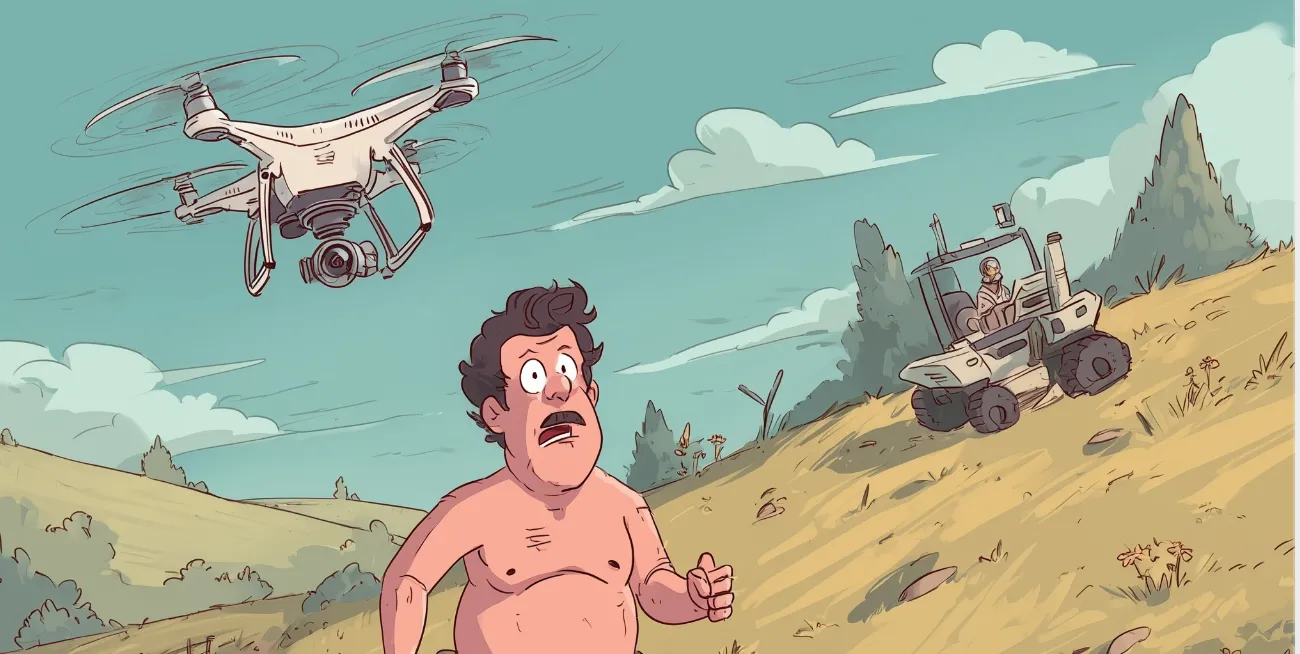
It was a quiet Sonoma County afternoon, the kind where the light comes through the eucalyptus along the Joe Rodota Trail and cyclists glide past like they’re in a tourism ad. Dog walkers. Runners. A few people commuting between Santa Rosa and Sebastopol. The usual parade of Lycra, coffee cups and slightly overconfident golden retrievers.
Then someone looked up and saw the drone.
Not a hobbyist toy buzzing around a vineyard. This was a sheriff’s drone, the official kind, the kind that means something has happened. It hovered over the trail like a suspicious metal dragonfly, slowly sweeping the tree line.
And somewhere below it, deputies were looking for a man who had decided—at some point earlier that day—that pants were optional.
Residents had already reported a backyard surprise: a man wandering around naked. Later came more calls along the trail. Same guy, same lack of clothing, now apparently taking a stroll through one of the county’s busiest bike corridors like it was perfectly normal to go out for a midday constitutional dressed exclusively in skin.
The response was impressive. Deputies on the ground. A search of nearby encampments. And overhead, the drone, quietly scanning the path.
Modern law enforcement technology is extraordinary when you think about it. These machines are used for wildfire mapping, search-and-rescue missions, disaster response and, occasionally, blowing up shit on battlefields halfway around the world. In Sonoma County they can also be deployed for something far more local: locating one extremely unclothed man wandering along a bike trail.
Somewhere in a sheriff’s report there is almost certainly a sentence that reads something like: “Suspect located via aerial surveillance. Still naked.”
Which raises a question about the law.
Contrary to what people assume, California doesn’t actually have a blanket ban on nudity in public. The charge prosecutors usually use is indecent exposure, which requires proof that someone deliberately exposed themselves with the intent to sexually arouse themselves or offend other people.
That’s an important distinction.
Because if you’re naked in public accidentally, or because you’ve made some deeply questionable life decisions, that alone isn’t necessarily the crime. Prosecutors have to show intent.
Of course, when you are strolling naked through someone’s backyard and then continuing the journey down an eight-mile public trail full of cyclists and dog walkers, a prosecutor may feel pretty comfortable making that argument.
If convicted under California’s indecent exposure law, a first offense is generally a misdemeanor punishable by up to six months in jail and a $1,000 fine.
Which means the theoretical legal consequences of the Great Naked Trail Incident are relatively straightforward: a few months in jail, a thousand bucks, and the permanent knowledge that a sheriff’s drone once hovered overhead while deputies tried to figure out how to politely tell you to put on pants.
Still, the real mystery here isn’t the law. It’s the moment of decision.
At some point that day, this man woke up and decided to go outside. The trail was busy. The sun was out. Cyclists were passing by at twenty miles an hour. People were walking their dogs.
And he thought: sure, why not.
Most of us hesitate before leaving the house without checking the weather or grabbing a jacket. This guy skipped clothing entirely and went straight to the scenic bike route.
The drone eventually helped deputies locate him. Technology triumphed. Order was restored. Pants, presumably, were introduced back into the situation.
But for a brief window of time, Sonoma County’s advanced aerial surveillance program was focused on a single mission: hovering above the redwoods, scanning the trail, and tracking a man who had decided the best way to enjoy a sunny afternoon was exactly the way nature intended.
Just with a drone watching.
Leave a Reply