
Acceso lingüístico en el Condado de Sonoma: la política existe — pero ¿y la realidad?
Sonoma County’s Spanish gap in public safety
Sonoma County has a language access policy and a plan to go with it. There are forms. There’s a bilingual testing process. There are even pay differentials for certain designated positions.
What we don’t have — at least not in public — is a straight answer to a simple question:
How many bilingual deputies are actually on duty when you call 911?
That question came up again at a recent meeting of the Community Advisory Council for IOLERO, the Independent Office of Law Enforcement Review and Outreach. The agenda wasn’t “Spanish access,” exactly. But it kept surfacing the way it does in real life: as a practical, operational issue that affects whether people feel safe and understood in the moment.
Spanish is the most common non-English language in Sonoma County. Roughly one in 10 residents speaks Spanish at home. In some neighborhoods and parts of the county, it’s much higher than that. If you’re in an emergency, or getting pulled over, or trying to navigate a jail booking, communication isn’t a nice extra. It’s the whole ballgame.
The county deserves credit for doing real policy work here. In 2024, the Board of Supervisors adopted a formal countywide language access policy. The goal is “meaningful access” for residents who prefer to communicate in languages other than English — translation, interpretation, accountability, the whole structure.
Human Resources also runs a bilingual proficiency process. Employees can be tested and certified to use Spanish (or other languages) in official duties. In theory, that creates a reliable pipeline for bilingual capacity across departments.
On paper, Sonoma checks the boxes.
But at that IOLERO advisory meeting, the gap between policy and deployment was hard to ignore. People talked about language as an ongoing challenge. The IOLERO director pointed council members to a community-oriented policing report released in December that found modest but persistent differences in how Spanish-speaking residents reported their interactions with deputies compared to English speakers. He said plainly that there was a difference.
And then, as often happens, the conversation drifted to the missing basics: numbers and coverage.
How many Spanish-certified deputies does the Sonoma County Sheriff’s Office currently have? How many are on patrol on any given shift? How many are in the jail? Is there guaranteed bilingual coverage 24/7 — or does it depend on who happens to be working?
There wasn’t an answer offered in the room. And those numbers aren’t published in a way the public can easily find.
The Sheriff’s Office employs more than 650 staff across the county. Patrol alone covers huge territory — rural roads, small cities, unincorporated communities — from Sonoma Valley to the coast to Cloverdale. That’s exactly why staffing distribution matters. It’s not enough to say “we have bilingual deputies” if they’re concentrated in one unit, one station, one shift, or one side of the county.
During public comment, one longtime observer put a sharper point on it: “bilingual” on paper doesn’t automatically translate to field-ready fluency. Anyone who’s worked in public systems knows that. Conversational Spanish is not the same as explaining rights under stress, de-escalating a volatile call, conducting jail medical intake, or taking a complaint that has to be accurate down to the detail.
To the Sheriff’s Office’ credit, language access isn’t limited to who speaks what. Deputies rely on body-worn camera footage, written reports and other documentation, and telephonic interpretation services exist countywide. But the real questions are the boring ones — which are usually the important ones. Is interpretation immediate? Is it routinely used? Is it tracked? Do deputies get trained to use it consistently, or is it “if you remember”?
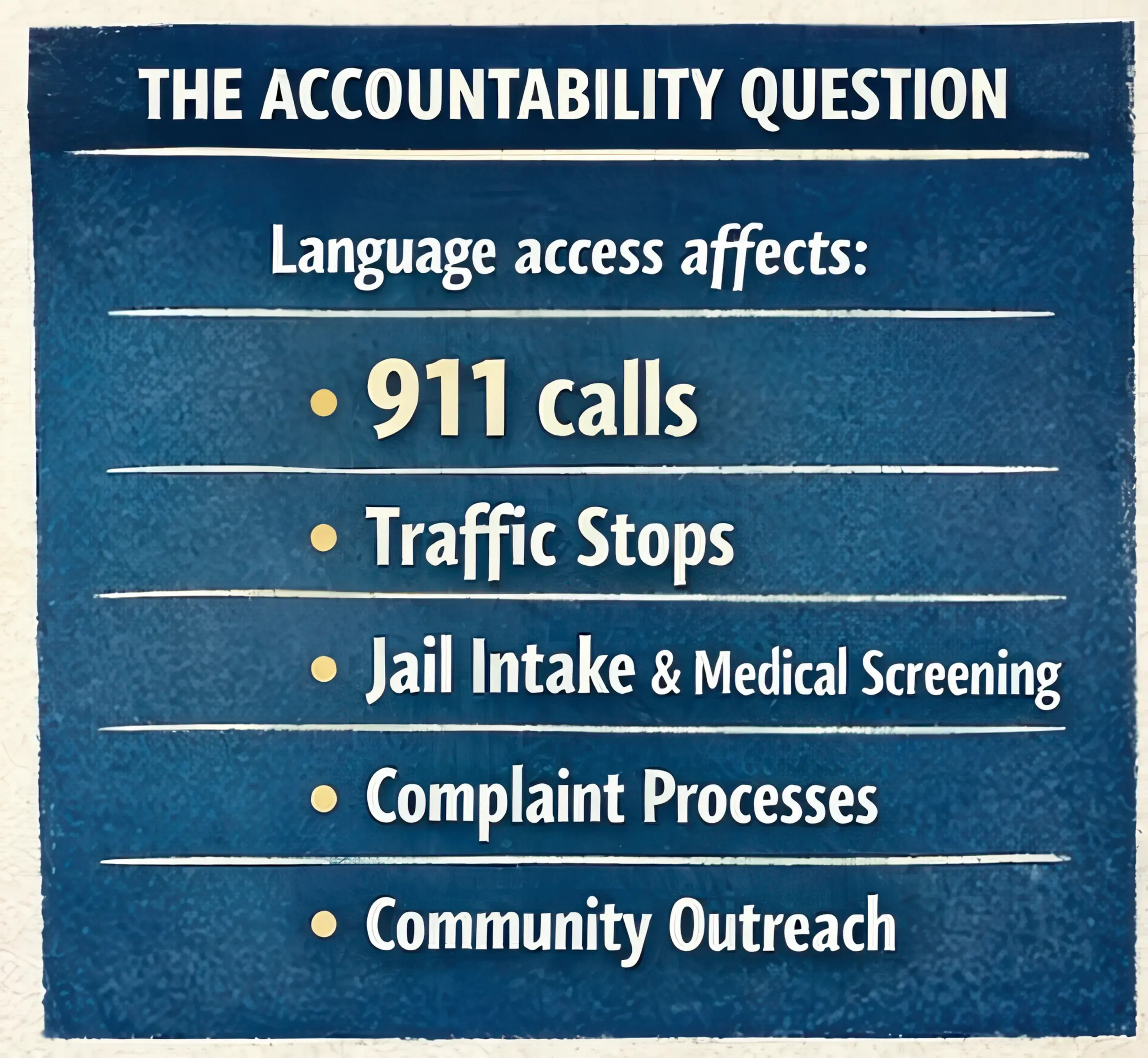
Language access also isn’t just patrol. It’s 911 dispatch. It’s jail booking and medical screening. It’s whether a family can understand what’s happening when a loved one is in custody. It’s whether filing a complaint with IOLERO is actually usable in Spanish, start to finish.
The county has built a framework. That’s real progress. But trust doesn’t come from a policy PDF. It comes from what happens on a Tuesday night in Roseland, or a roadside stop outside Sebastopol, or a booking desk at the jail.
If we want language access to be more than a promise, Sonoma needs to do the unglamorous part next: publish the numbers and show how Spanish coverage is actually deployed.
Because in a crisis, “we have a policy” isn’t the same thing as having someone who understands you.
Acceso lingüístico en el Condado de Sonoma: la política existe — pero ¿y la realidad?
El Condado de Sonoma tiene una política de acceso lingüístico. Tiene un plan. Tiene formularios. Tiene un proceso para evaluar a empleados bilingües.
Lo que no parece tener — al menos públicamente — es una respuesta clara a una pregunta bien sencilla:
¿Cuántos oficiales bilingües están realmente de turno cuando llamas al 911?
El español es el idioma más común después del inglés en el Condado de Sonoma. Más o menos uno de cada 10 residentes habla español en casa. En algunas comunidades, ese número es mucho más alto. En una emergencia, o durante una parada de tráfico, o al momento de registrar a alguien en la cárcel, la comunicación no es una cortesía. Es cuestión de seguridad.
En 2024, la Junta de Supervisores adoptó una política formal de acceso lingüístico para todo el condado. El documento compromete a los departamentos a ofrecer acceso real a residentes que prefieren comunicarse en idiomas que no sean inglés. Describe procedimientos de traducción, interpretación y rendición de cuentas. Es bien pensado. Ya se había tardado. Y es de a deveras.
El condado también tiene un proceso de certificación bilingüe a través de Recursos Humanos. Los empleados pueden ser evaluados y certificados para usar español (u otros idiomas) en sus funciones oficiales. Hay diferencias de pago para ciertos puestos designados.
En papel, la estructura está.
Pero cuando preguntas cuántos oficiales de la Oficina del Sheriff del Condado de Sonoma están actualmente certificados como bilingües en español — y cómo se distribuyen entre turnos de patrulla y asignaciones en la cárcel — no hay un número disponible al público.
La Oficina del Sheriff emplea a más de 650 personas en todo el condado. Solo las patrullas cubren áreas rurales enormes, ciudades pequeñas y comunidades no incorporadas desde Sonoma Valley hasta la costa y hasta Cloverdale. Sin embargo, la agencia no publica cuántos oficiales juramentados están certificados en español, cuántos están de turno por cada turno, ni si la cobertura bilingüe está garantizada las 24 horas, los 7 días de la semana.
Y eso importa.
Porque en la vida real, el acceso lingüístico muchas veces depende de quién le tocó trabajar ese día.
En reuniones recientes del Consejo Asesor Comunitario de IOLERO (la Oficina Independiente de Revisión y Alcance de las Fuerzas del Orden del condado), el tema del idioma salió otra vez. El informe de policía comunitaria publicado en diciembre señaló diferencias modestas pero persistentes en cómo los residentes hispanohablantes reportan sus interacciones con oficiales, comparado con los angloparlantes.
La recomendación fue directa: seguir contratando oficiales que hablen español y considerar modelos de capacitación que se usan en otros lugares para mejorar la comunicación en comunidades donde la gente duda en acercarse a las autoridades.
Durante los comentarios públicos, un observador del condado con muchos años de experiencia fue al grano: ponerle la etiqueta de “bilingüe” a alguien en papel no quiere decir que pueda manejar efectivamente un encuentro de alta presión en español.
Cualquiera que haya trabajado en sistemas públicos sabe la diferencia entre hablar español en conversación y manejarlo a nivel profesional en el campo. Explicar derechos. Calmar una situación tensa. Hacer una evaluación médica en la cárcel. Tomar una queja. Todo eso requiere precisión.
La Oficina del Sheriff sí usa cámaras corporales, reportes escritos y otra documentación para revisar incidentes. También hay servicios de interpretación telefónica disponibles en todo el condado. Pero otra vez, la pregunta clave es la consistencia. ¿La interpretación es inmediata? ¿Se usa de manera rutinaria? ¿Se lleva un registro?
El acceso lingüístico no se trata solo de las patrullas. Se trata del despacho del 911. Se trata de los registros en la cárcel. Se trata de las evaluaciones médicas. Se trata de cómo alguien presenta una queja ante IOLERO. Se trata de si un familiar puede entender lo que está pasando cuando un ser querido está detenido.
El condado ha dado pasos reales. La política de acceso lingüístico no fue simbólica. Surgió después de participación comunitaria y talleres. Creó un puesto de coordinador. Exige que los departamentos monitoreen y mejoren.
Eso está bien.
Pero la confianza no viene de documentos en PDF. Viene de la experiencia.
Si te paran en Roseland a las 10 de la noche, ¿el oficial va a poder explicarte lo que está pasando en español? Si eres un trabajador del campo hispanohablante que llama al 911 en una emergencia, ¿el despachador te va a entender de inmediato? Si a tu papá o tu mamá los registran en la cárcel, ¿las instrucciones médicas se las van a dar en un idioma que realmente comprendan?
Esas no son preguntas teóricas en el Condado de Sonoma. Son realidades de todos los días.
El condado merece reconocimiento por construir la estructura. Ahora necesita mostrar los números — y el despliegue — que la respalden.
Porque en una crisis, “tenemos una política” no es lo mismo que “te entendemos.”
Leave a Reply